Alert, Bulletin or Full Report: What Each Format Leaves Out
Compare news alerts, bulletins and full reports to choose the format that answers your immediate question without mistaking a brief update for the whole story.
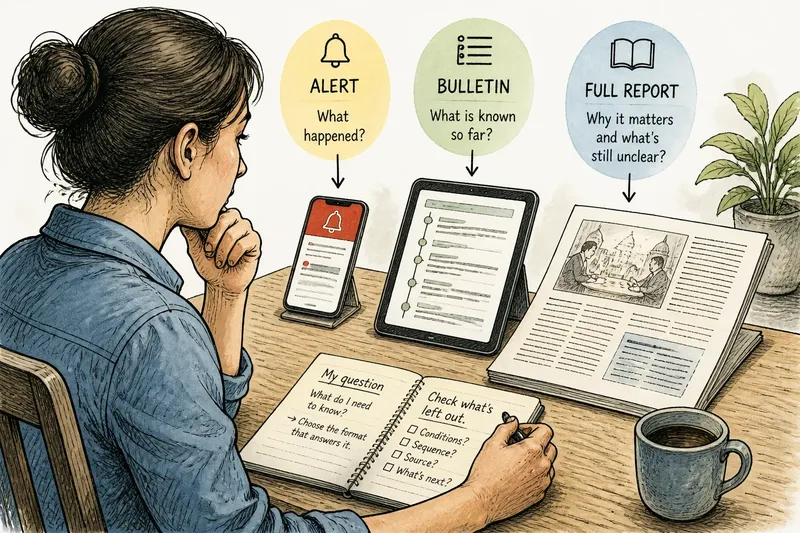
The most common mistake with news alerts, bulletins and full reports is expecting one format to do another’s job. A news alert can tell you that a development matters; it rarely explains what led to it. Confusing a brief notice with a fuller account can leave you with a strong impression and too little context to judge what follows.
These formats are different containers, not successive grades of truth. An alert is like a note slipped under a door: useful for knowing something has happened, poor at carrying the whole conversation. Choose according to the question you need answered, then notice what the format leaves out.
What alerts leave out
An alert is designed to interrupt. It may announce a decision, an emergency, a resignation or a major change in a developing story. Its short form makes it easy to notice, but compression can remove the conditions and sequence that give a claim meaning.
A headline such as “Council approves plan” might not say whether the vote was final, which parts were approved or whether implementation depends on another decision. The alert may be accurate and still leave you unable to say what happens next.
- Check whether the alert describes a completed event or a proposal; if it says “proposed,” treat the outcome as unsettled and look for the next decision point.
- Check whether it names the decision-maker or event; if it does, use that detail to locate the relevant public announcement, and if it does not, keep your interpretation narrow.
- Check whether the alert links to a bulletin or report; if it does, open that coverage when the consequences matter, and if it does not, avoid inferring details the notice omits.
- Check whether its wording describes an immediate effect or a future possibility; if the effect is conditional, preserve that condition in your understanding rather than treating it as certain.
Say you receive an invented alert that a school district is changing bus routes. It says the change is proposed, so you open the linked bulletin and see that a public meeting is still ahead. The resulting picture is clear enough to distinguish an announced proposal from a settled route change.
How bulletins track change
A bulletin gathers updates as facts arrive. It can make a developing story easier to follow, but its entries may differ in purpose: one may add a new event, another may clarify an earlier detail, and another may record a response.
Read the entry that answers your question, not merely the newest line. A bulletin’s opening summary can provide the broad outline; its dated entries show how that outline changed.
- Check the time on the specific entry you are relying on; if it is older than a later correction, use the correction, and if no later entry addresses it, retain the original time context.
- Check whether the entry says “confirmed,” “reported,” “expected” or “under investigation”; if it describes an unresolved matter, keep it unresolved, and if it reports confirmation, note exactly what was confirmed.
- Check for a correction or revision notice; if one changes an earlier detail, replace that detail in your understanding, and if none appears, do not assume the earlier entry has been superseded.
- Check whether the story’s sequence affects the meaning; if it does, read the relevant entries in order, and if it does not, use the entry that addresses your immediate question.
- Check whether the opening summary reflects later developments; if it does not, rely on the newer entry for the changed detail while keeping the summary’s broader context.
A bulletin can preserve uncertainty by showing that one point has been announced while another is still being clarified. That is useful only if “still being assessed” remains distinct from a settled explanation.
What reports explain
A full report gives a journalist more room to explain what is known, how the information was obtained and what remains unresolved. It may include background, attributed accounts and responses from people or institutions involved.
Length does not make a report complete. It may explain a decision while leaving its practical effects unknown, or quote a source without having access to records that could independently confirm that account. Read for the scope of the explanation, not just its fluency.
- Check what the report presents as its central finding; if it is supported by the details described, distinguish it from background and interpretation, and if support is unclear, avoid treating it as established.
- Check whether the report explains how a claim was obtained; if it identifies a document, interview or direct observation, use that to understand the claim’s basis, and if it does not, recognize that the basis is unspecified.
- Check the closing paragraphs and any update note; if they name unanswered questions or later developments, include those limits, and if they do not, do not assume every relevant question has been resolved.
- Check whether the headline is broader than the account; if it is, follow the narrower claim supported in the report, and if it is not, retain the scope the story actually describes.
This is not a reason to distrust every narrative. A report can be the best format for understanding a complicated decision while still leaving open what that decision will mean in practice.
Which news format fits?
Which format suits a quick update?
Use an alert when you need to know that an event has occurred and can accept limited explanation. If the update could affect a decision you need to make, treat it as a prompt to read more rather than the whole account.
How does a bulletin differ from a full report?
A bulletin organizes successive updates as a story develops, while a full report shapes available information into a more continuous explanation. The bulletin emphasizes change over time; the report usually gives more context in one reading.
Can a full report become out of date?
Yes. A report may accurately describe what was known when it was published and become incomplete as events change. Check its update note and compare it with newer coverage before treating it as current.
When should an alert prompt more reading?
Follow up when the alert leaves out a condition or consequence that matters to your understanding. If it has no link, keep your conclusion limited to its explicit claim rather than filling the gap with an assumption.
Match format to question
Choose by the uncertainty you need to reduce. An alert may answer “What happened?” A bulletin can help with “What is known so far?” A full report is more suited to “Why did this happen, and what supports that account?”
Imagine an invented town council story: an alert says members approved a waterfront plan, a bulletin later clarifies that the vote covered only a proposal, and a full report explains that a separate permit remains undecided. Your starting point is the alert’s broad wording; you then use the bulletin to identify the vote’s limited scope and the report to find the outstanding permit. The resulting answer is that a proposal advanced, but the project is not yet cleared to proceed.
When two formats appear to disagree, compare the specific claims and their publication or update times. One may describe an early account while another reflects a later clarification; if the difference remains, keep the claims separate until the wording and cited basis make their relationship clear.
Keep conclusions bounded
The best format is the one that answers your present question without encouraging a larger conclusion than its contents support. An alert can orient you, a bulletin can show changes over time, and a full report can explain available context and evidence.
For a quick check, ask what the format is designed to deliver, what it leaves out, and whether that omission matters to your question. That pause helps you use a news alert, bulletin or full report on its own terms—and decide when more coverage is needed.