The Screenshot Is Not the Whole Claim
Check a news screenshot against its date, speaker and missing context so you can tell what the excerpt supports before sharing its larger claim.
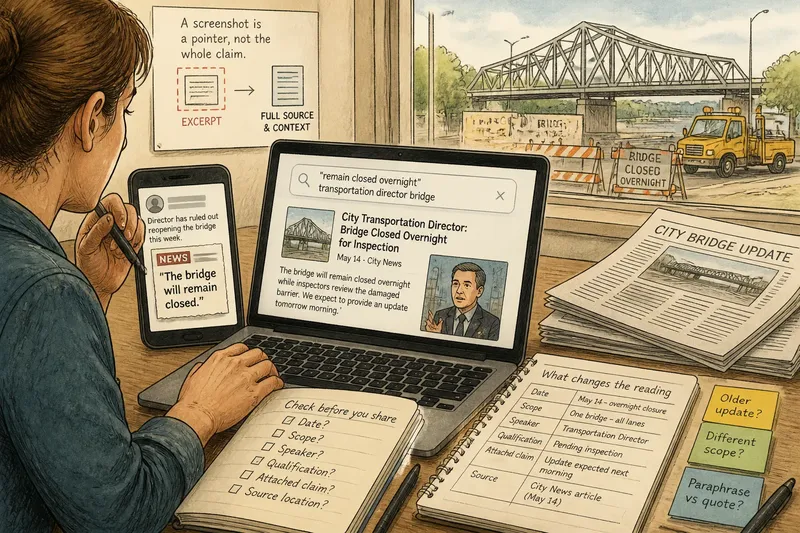
The most common mistake with a news screenshot is treating the visible sentence as the entire claim. That shortcut can turn a cautious remark into an accusation, or an old update into apparent breaking news; the cost is a conclusion the full source may not support. A screenshot is a useful pointer, not the whole claim.
A cropped sentence
Say you receive an image in a neighborhood group showing a sentence attributed to a city transportation director: “The bridge will remain closed.” Above it, the post says the director has ruled out reopening the bridge this week. The image includes a news outlet’s logo, but no headline, publication date, link or surrounding paragraph.
It is reasonable to pause before forwarding it. “Remain closed” sounds definite, but could refer to an overnight closure, a particular lane or a period that has already passed. The crop does not tell you which reading fits.
Start by noting what the image establishes: a sentence is attributed to a named official and appears beside a news logo. It does not establish when the sentence was said, what “the bridge” refers to, or whether the official described a decision, a possibility or a temporary condition.
Words and claims
The post adds a conclusion that is not visible in the quotation: “ruled out reopening this week.” That may be accurate, but it is a separate claim. Keep the quoted words distinct from the conclusion attached to them so the framing around an image does not quietly become part of the source.
Write down the words shown and the conclusion the sharer wants you to draw. Then ask what information would connect them. Here, you would need the statement’s date, the closure’s scope and whether the director was discussing the current week.
This is not a reason to distrust every image. It is a way to notice the distance between visible evidence and an interpretation. A cropped sentence is like one line from a letter: the words may be exact, while a missing qualification changes what they mean.
Find the fuller source
Use the image as a search clue. Search a distinctive phrase from the quotation alongside the official’s name and the outlet name. If the screenshot includes a headline fragment, date or location, add those details to help distinguish one report from another.
Look for the source page or a fuller version of the report, then check the passage around the excerpt. Determine whether the wording appears in a transcript, news story, public notice or social post. A reporter’s paraphrase is not the same as an official’s exact words.
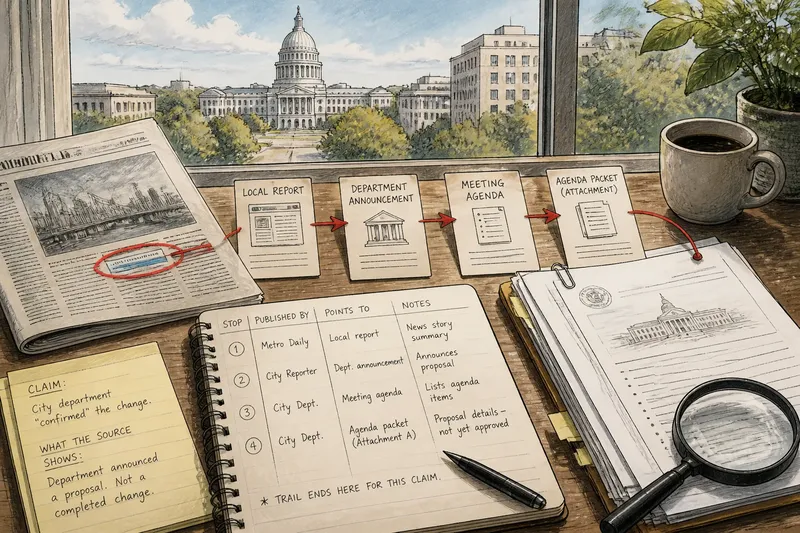
Imagine the search leads to a dated article about the bridge. The full paragraph says it will remain closed overnight while inspectors review a damaged barrier, and the director expects to give an update the next morning. That context supports an overnight closure at the time of the statement, but not the post’s claim that reopening was ruled out for the week.
If you cannot locate the original page, check the outlet’s archive or the named agency’s public updates. Keep the unresolved details explicit; a missing source is a reason to hold back a firm conclusion, not proof that the screenshot is false.
Date, scope and speaker
Three details often change how a cropped claim reads: when it was made, what it covers and who is speaking. A post can circulate long after publication; a statement about one lane can be framed as a decision about an entire route; and a headline may summarize a reporter’s account rather than quote the person named.
- Date: Check for a publication or statement date. If it predates the event being discussed, treat the image as an older update and look for a newer source; if the date is absent, do not describe it as current.
- Scope: Check whether the excerpt names a location, group, time period or part of a policy. If it limits the claim, keep that limit in your description; if the scope is missing, avoid applying it to a broader area or decision.
- Speaker: Check whether the words are in quotation marks and attributed directly, or presented as a reporter’s summary. If they are a paraphrase, describe them as a report of the speaker’s position; if attribution is unclear, leave the speaker unconfirmed.
- Qualification: Check the sentences before and after the excerpt for conditions, uncertainty or a later clarification. If they narrow or alter the meaning, include that qualification; if the surrounding text is unavailable, say the excerpt is incomplete.
- Attached claim: Compare the source wording with the conclusion in the post. If the conclusion goes beyond the excerpt, share only the narrower supported point; if the source supports it, link the fuller passage so readers can see the basis.
- Source location: Check for a working link, publication name or identifiable agency record. If you find a fuller source, use it to verify the excerpt; if you do not, describe both the wording and attribution as unconfirmed.
These checks matter even when an image is genuine. A real screenshot can mislead through selection, timing or a caption that asserts more than the excerpt does.
Questions about crops?
Does a real screenshot prove the claim?
No. It may accurately reproduce a fragment while leaving out context that limits its meaning. Check what the visible text supports separately from the conclusion added by the caption.
What if the quotation appears nowhere else?
Search a distinctive phrase with the speaker’s name and the outlet or organization shown in the image. If no fuller source turns up, treat the wording and attribution as unconfirmed rather than inventing an explanation.
How can I tell quotation from paraphrase?
Quotation marks usually signal exact wording, while a report may summarize someone’s position in the reporter’s voice. Check the punctuation and attribution, and look for a transcript or recording when exact wording matters.
When is a crop useful to share?
A crop can be useful if it is presented as an excerpt and connected to the fuller source. For a disputed or consequential claim, include the relevant date and context, or wait to share it as settled fact.
Share what the source supports
After checking the source, describe the result as precisely as the evidence allows. In the bridge scenario, a careful message would say the official described an overnight closure pending inspection, rather than claim the city had ruled out reopening for the week.
If the fuller passage changes the reading, share the link or the relevant context with your correction. Make clear what the original post overstated without repeating its strongest wording as if it were confirmed.
When the date, speaker or missing passage remains unresolved, say which detail you could not verify. The screenshot is not the whole claim, and the useful next move is to state only what the available context can support.